Why FinOps Is a Quality Problem, Not Just a Finance Problem
FinOps programs fail not because companies lack tooling or data — but because nobody validates that the tooling, data, and processes are working correctly. This is a quality problem.
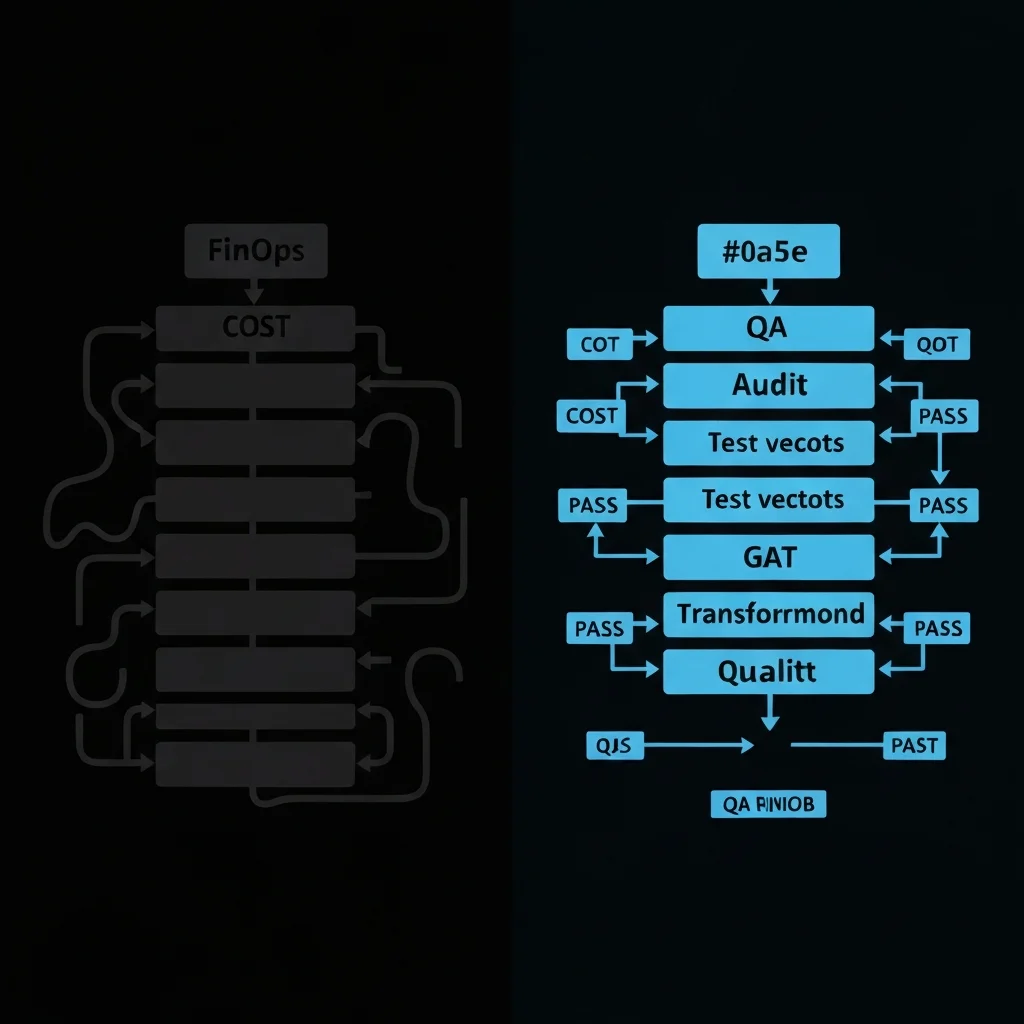
Every FinOps program I’ve audited has the same structure: a dashboard, some alerts, a tagging policy, and a weekly cost review meeting. And in almost every case, at least two of those four things are broken in ways nobody has noticed.
The dashboard shows numbers that don’t reconcile with the invoice. The alerts have routing that hasn’t been updated since the team changed. The tagging policy covers 80% of resources and 55% of spend — because 20% of resources are your most expensive ones. The weekly meeting reviews data from a tool that’s 3% off on shared resource attribution.
The problem is not a lack of tooling or data. The problem is that nobody is testing whether the tooling and data are correct.
This is a quality problem. And it requires a quality solution.
The Software QA Analogy
In software engineering, you would never ship a critical system without testing it. You write test cases. You define pass/fail criteria. You run regression tests. You track defects, classify them by severity, and don’t accept a release until the P0 defect count is zero.
FinOps implementations are shipped without any of this.
The tagging strategy is “implemented” — meaning someone added tags to most resources, and the dashboard shows 80%+ coverage. Nobody wrote test cases. Nobody defined what 80% actually means in spend terms. Nobody validated that the allocation rules produce accurate output when tags are present.
You wouldn’t ship code without tests. Why do you trust your cloud bill without testing it?
What FinOps QA Looks Like
FinOps QA applies software testing methodology to cloud financial operations:
| QA Concept | FinOps QA Equivalent |
|---|---|
| Test case | Cost allocation rule validation, tagging coverage check, alert threshold test |
| Defect | Billing error, untagged resource, misconfigured alert, orphaned resource |
| Defect severity | P0 = active financial loss >$10K/mo; P1 = attribution error >5% of spend |
| Test coverage | % of cloud spend with valid, tested cost attribution |
| Regression | Cost anomaly that reappeared after remediation |
| CI/CD gate | Cost gate in pipeline — PR blocked when estimated monthly cost exceeds threshold |
| QA retainer | Ongoing FinOps health monitoring with monthly defect reports |
The Four Layers Where FinOps Defects Hide
Layer 1: Tagging — Not resource coverage, but spend-weighted coverage. A single untagged NAT Gateway at $8K/month is statistically invisible in a resource-count metric but financially material.
Layer 2: Alerting — Budget alerts that fire to the wrong owner, with the wrong threshold, at the wrong latency. Most organisations discover their alerting has 3–4 broken configurations during a first FinOps QA assessment.
Layer 3: Tooling — FinOps tools report aggregate data by reconciling raw billing APIs — and they make errors in shared resource attribution, commitment discount allocation, and cross-provider aggregation. These errors compound over time.
Layer 4: Process — Rightsizing recommendations that are 90 days old and unacted on. Budget reviews with no defined owner. Alert thresholds set once and never updated as the environment grew.
The FinOps Defect Score
finops.qa quantifies FinOps health as a single 0–100 composite metric — the FinOps Defect Score. It is calculated from objective test case results, not consultant judgment. It is repeatable — the same test cases produce the same score regardless of assessor. And it is board-reportable.
The average first-assessment score across our client base: 47/100. Only 11% of organisations score above 70 on first assessment.
The good news: after remediation, clients typically reach 75–85 within 90 days. The Score is not a judgment — it is a starting point.
If your FinOps program has never been independently validated, the FinOps QA Assessment is the fastest way to know where you actually stand.
Get Your FinOps Defect Score
Book a free 30-minute cloud cost review. We will identify your top three FinOps gaps and give you a preliminary Defect Score — no pitch, no obligation.
Talk to an Expert